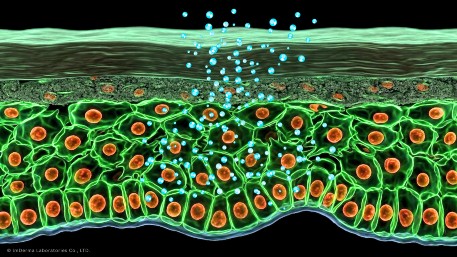
Human-derived exosomes are entering cosmetic applications — and percutaneous absorption data has become a critical foundation for both product development and regulatory evaluation.
Whether it's exosomes, peptides, or functional actives — does your ingredient actually penetrate the skin?
This is not just a marketing claim. It is the scientific basis for building credible, evidence-based products.
ImDerma Laboratories provides professional in vitro percutaneous absorption testing services, with study designs referencing international methodology (e.g., OECD TG 428 framework), combined with appropriate in vitro skin models and analytical methods to generate data applicable to product development and regulatory submission.
What Is a Percutaneous Absorption Study?
A Percutaneous Absorption Test evaluates the ability of active ingredients to penetrate the skin barrier and quantifies their distribution and absorption across different skin layers.
Key parameters provided include:
• Permeation flux (Flux)
• Permeability coefficient (Kp)
For exosomes, peptides, and functional actives, particle size, molecular weight, and carrier design directly influence actual skin absorption — making transdermal data an essential reference for product development.
The Value of Percutaneous Absorption Testing
Beyond regulatory compliance, this is a core tool for product development and market differentiation:
• Regulatory Support
Provides critical safety data required for TFDA case-by-case review and cosmetic safety assessments.
• Efficacy Substantiation
Supports ingredient skin penetration claims with measured data, strengthening product credibility.
• Formulation Optimization
Uses data-driven insights to refine delivery systems and dosage form design.
• Market Differentiation
Establishes a science-backed product positioning to enhance brand competitiveness.
Challenges in Exosome Percutaneous Absorption Testing
Exosomes range from approximately 30–200 nm in size, and their transdermal behavior differs significantly from conventional small-molecule ingredients. Study design must therefore consider:
• Selection of an appropriate in vitro skin model
• Analytical method suitability for nanoparticle detection
• Experimental conditions and data interpretation approach
ImDerma provides customized study design and data analysis recommendations based on the specific characteristics and intended application of each ingredient.
Percutaneous Absorption in Cosmetic Safety & Regulatory Submissions (PIF)
Percutaneous absorption data serves as an essential foundation for cosmetic safety evaluation:
• SED (Systemic Exposure Dose): used to calculate systemic exposure from dermal absorption
• CPSR (Cosmetic Product Safety Report): supports safety dossier preparation
• Influences ingredient use concentration and safety margin (MoS)
• Meets EU Regulation 1223/2009 safety assessment requirements
• Serves as a key methodological reference for non-animal testing alternatives (OECD TG 428)
Why Choose ImDerma Laboratories?
• First 2 companies in Taiwan to obtain TFDA approval for human-derived exosome cosmetic ingredients
• In-depth familiarity with TFDA review logic; provides technical report support and response assistance
• Study designs reference international methodology (OECD TG 428 and related guidelines)
• BSL-2 certified laboratory, audited and approved by competent authorities
• Extensive testing experience across exosomes, peptides, and functional cosmetic ingredients
Contact Us
Please feel free to reach out with your ingredient information. We will be happy to assist in evaluating your sample and arranging the appropriate testing plan.
info@imdermalab.com.tw
Tel:+886-3-575-2901
Office Hours:Monday – Friday, 08:00–17:00 (TST)